
ATTENTION: This document contains information from SecurityScan. Ltd. that is confidential and privileged. The information is intended for private use of the client. By accepting this document you agree to keep the contents in confidence and not copy, disclose, or distribute this without written request to and written confirmation from SecurityScan. If you are not the intended recipient, be aware that any disclosure, copying, or distribution of the contents of this document is prohibited. August, 10 , 2024
COPYRIGHT © SecurityScan, INC. All rights reserved.
| Title | Details |
|---|---|
| COMPLETED ON: | August, 11, 2024 |
| REPORT TYPE: | MANUAL SCAN |
| VALIDITY: | 30 DAYS |
This document contains the initial security assessment report for:
{ Goldcast Web Application and its Backend Dashboards. }
The purpose of this assessment was to point out security loopholes, business logic errors, and missing best security practices. The tests were carried out assuming the identity of an attacker or a malicious user but no harm was made to the functionality or working of the application/network.
Security assessment includes testing for security loopholes in the scope defined below. Apart from the following, no other information was provided. Nothing was assumed at the start of the security assessment.
The following was the scope covered under the security audit:
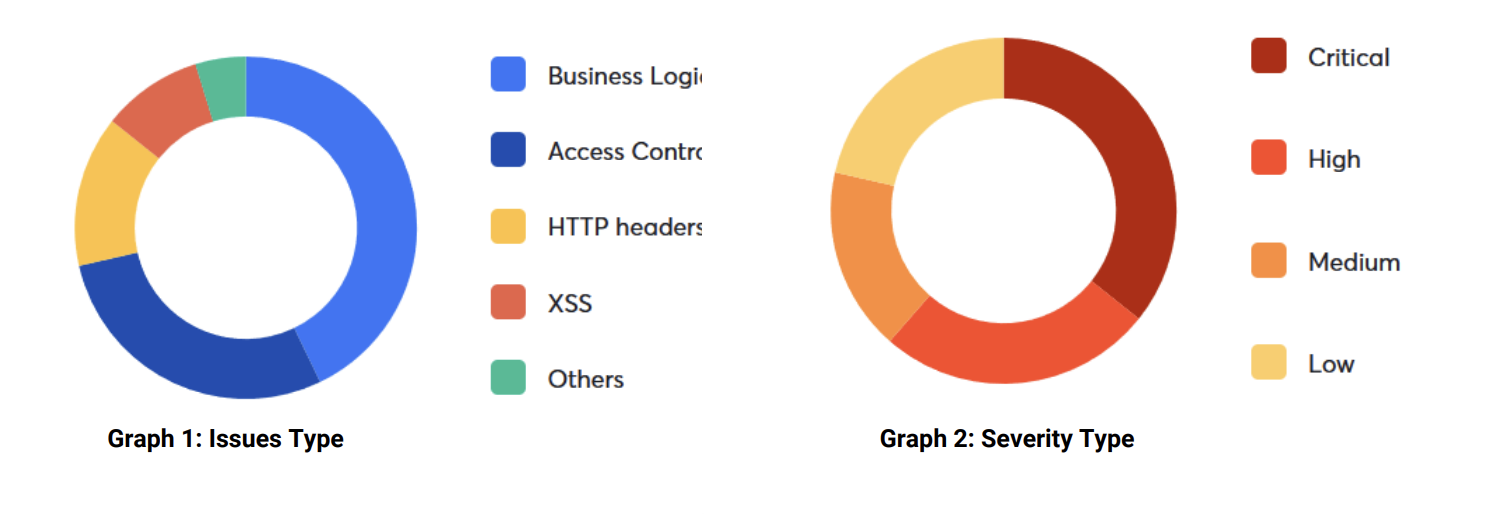
The below graphical representations from Astra's VAPT dashboard will provide you an overall summary of the security audit scan results, including:
| # | Vulnerability | Severity | CVSS | Score | Status |
|---|---|---|---|---|---|
| 1 | SQL Injection | High | 7.8 | Critical | Open |
| 2 | Cross-Site Scripting | Medium | 6.4 | High | Closed |
| 3 | Buffer Overflow | Critical | 9.0 | Critical | In Progress |
| 4 | Broken Authentication | High | 7.5 | High | Open |
| 5 | Insecure Direct Object References | Medium | 6.0 | Medium | Closed |
| 6 | Security Misconfiguration | High | 7.3 | High | Open |
| 7 | Insufficient Logging & Monitoring | Low | 5.2 | Medium | In Progress |
| Vulnerability Severity | No. of Vulnerabilities Found |
|---|---|
| Critical | 0 |
| High | 1 |
| Medium | 4 |
| Low | 4 |
| Recommendations | 0 |
Missing API Security Headers
| Severity | Status |
|---|---|
| Medium | Unsolved |
5.4
We were able to detect that the following API security headers are missing:
A Content Security Policy (CSP) is an important standard by the W3C aimed at preventing a broad range of content injection attacks such as cross-site scripting (XSS), data injection attacks, and packet sniffing attacks. It is a declarative policy that informs the user agent what are valid sources to load resources from.
The recommended Configuration for API Endpoint is:
In Content-Security-Policy: default-src 'none'; frame-ancestors 'none' \n Strict-Transport- Security: max-age=63072000\n X-Content-Type-Options: nosniff\nStored Cross-Site Scripting (XSS)
| Severity | Status |
|---|---|
| Medium | Unsolved |
7.7
Stored XSS Vulnerability was found on the affected URLs. This allows an attacker to inject a script which gets stored in the application. When a victim navigates to the affected web page in a browser, the XSS payload will be served as part of the web page. This means that victims will inadvertently end up executing the malicious script once the page is viewed in a browser.